

 LLC Taxation Options – Overview
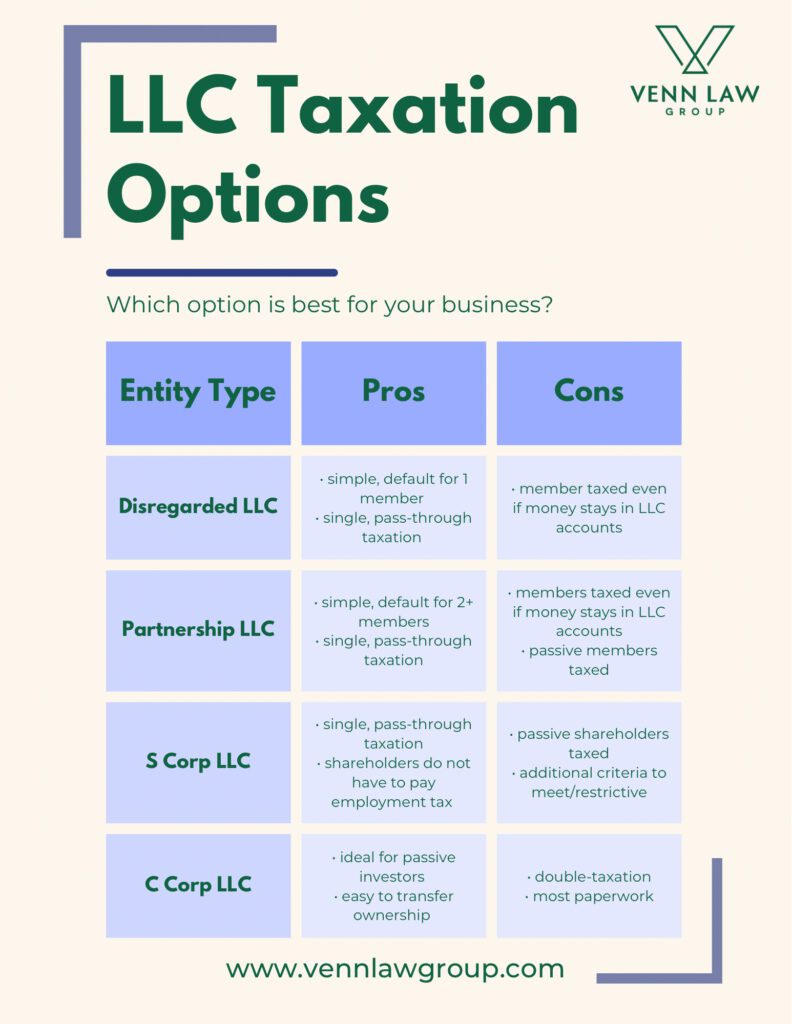
Being one of the most flexible entities, limited liability companies (LLCs) have several taxation options. However, there are many factors to consider when choosing which tax option works best for your LLC, such as the number of members, financial goals, and future plans for the LLC.
Concerning LLC taxation, there are two broad categories to choose from: pass-through taxation and corporation taxation. From there, pass-through taxed LLCs have two subcategories: disregarded and partnership. Corporation-taxed LLCs also have two subcategories: S corp and C corp. Each of the four taxation options for LLCs offers different pros and cons.
Pass-Through Taxed LLCs
If you create an LLC and do not choose how the LLC should be taxed, the LLC will be taxed as a pass-through entity based on the number of members. The default tax classification for an LLC with one member is a disregarded entity, and the default tax classification for two or more members is a partnership. In either of these cases, the LLC is a pass-through entity, meaning the LLC’s income is not directly taxed but instead “passes through” to the members, who then pay the associated taxes on their individual income tax returns.
- Disregarded LLCs
A disregarded LLC, as stated above, is typical for an LLC with a single member. This kind of LLC is not treated as taxable by the Internal Revenue Service (IRS) since the income passes to the member. Even if earnings are kept in the LLC’s bank accounts and not the single member’s account, the single member still will be taxed on the income on their personal taxes. A pro to this tax status means the income only gets taxed once at the individual level. However, a con is that all income gets taxed, even if not in the individual’s bank account. Further, the member cannot receive a W-2 as an employee of an LLC taxed in this manner.
Disregarded tax status is a good option for most business owners, especially new owners, as this is a simple taxation option that can automatically be applied to the LLC. In addition, this option does not require any additional paperwork to be taxed as a pass-through entity. However, if you plan on keeping income in the LLC for several years, this tax option may not be the best.
- Partnership LLCs
A partnership LLC is the same as a single-member disregarded LLC, just with more than a single member. Since it is essentially the same as a disregarded entity, it is also not directly taxed by the IRS. The income of these multi-member LLCs “passes through” to the members, who then are taxed according to their share of ownership in the LLC. Again, the pro is that the income is only taxed once following this option. However, a con is that even if a member did not receive any income from the LLC, all members must pay their share of the LLC’s income on their individual tax returns. Also, none of the members of the LLC can receive a W-2 as an employee of an LLC taxed in this manner. Their income is typically taxed as self-employment income.
For example, if five individuals create an LLC, the LLC will be taxed as a partnership by default. If each of the five members owns 20% of the LLC and the LLC makes $100,000 in 2023, each of the five members will be allocated $20,000 of taxable income from the LLC on their individual income taxes. Even if four members received some distribution of the profits and the other one member never received a distribution, all five members must pay their share of the taxes based on the allocated income, not the actual cash received. Thus, this option is not always a good fit for LLCs with passive members.
Corporation Taxed LLCs
Since corporation tax status for an LLC is not the default classification, the LLC members must elect for it to be taxed as an S or C corp, meaning additional forms must be filed with the IRS, and specific criteria must be met. However, a corporation-taxed LLC can be a single-shareholder or multi-shareholder LLC. The corporation tax status for an LLC is solely for tax purposes; it does not affect the LLC as an entity from an operational standpoint.
- S corp LLC
An S corp taxed LLC, named after the Subchapter S of the Internal Revenue Code, is available for corporations and LLCs. Like pass-through LLCs, S corp LLCs do not pay federal income tax. Instead, the profits are passed through to the member or members, who are then taxed on the individual level based on profits allocated to them based on their percentage of ownership interests in the LLC. A pro of this system is active business shareholders can be considered employees of the S corp LLC and receive regular pay net of typical tax withholdings as a W-2 employee, and the S corp LLC thus pays the payroll tax like other typical employers.
Similar to pass-through entities, a pro of this pass-through of income to the members allows one level of taxation. Again, however, the con is all members are taxed on the LLC’s income, even if the members did not receive any of the income. Additionally, all members actively participating in the LLC’s operations must be paid a “reasonable salary.”
To have an LLC be elected as an S corp for taxation purposes, the LLC must meet the following criteria:
- Be comprised of only certain classes of members. The members may not be partnerships, corporations, or non-resident aliens;
- Have no more than 100 members; and
- Have only one class of ownership.
- C corp LLC
A C corp taxed LLC, the most unique tax status of an LLC, pays taxes on the LLC’s annual earnings. The C corp LLC pays taxes directly on its taxable income and then may distribute profits to members. The members pay tax on the distributions only. Thus, this is the only LLC tax option at two levels, the LLC and member levels, or “double taxation.”
Unlike S corp LLCs, C corp LLCs can have any number of members and classes of ownerhip, and transferring ownership is generally easier than other tax options. Thus, this option can be the best for those businesses looking for outside or passive investors and owners. However, the cons of C corp LLCs are that it requires the most paperwork and incurs additional income taxes.
Final Considerations
Every LLC should have an effective operating agreement regardless of its tax status. In addition, some states require an operating agreement for LLCs. An operating agreement is essentially the contract between the members themselves and the LLC. It sets out how the entity will be taxed, how the members get distributions, their rights and duties, and how the LLC will function.
LLCs are limited in how often they can change their tax status, so members cannot easily change from one status to another year after year. It is crucial to know what tax status, forms, and agreements should be in place for your business to achieve your financial goals and future plans and properly comply with the IRS rules and requirements.
For more information about Venn Law Group’s Corporate and Tax Planning legal services, visit www.vennlawgroup.com/practice-areas/corporate.